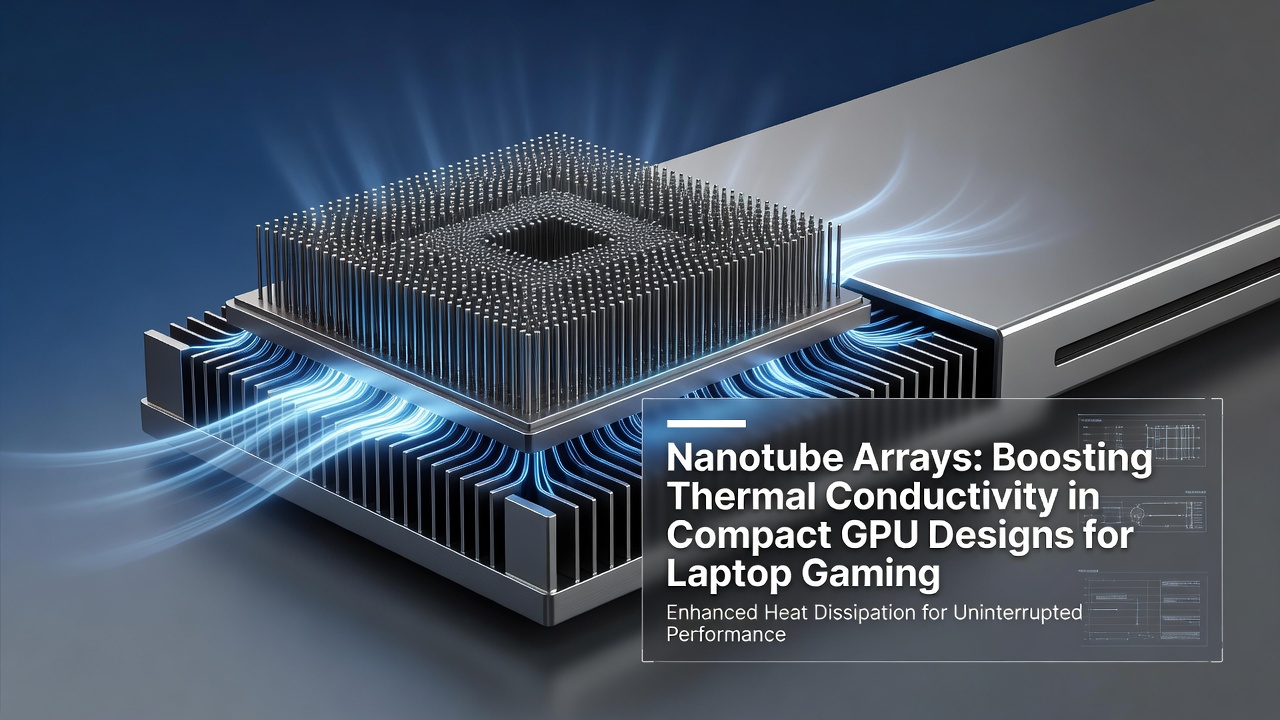
Nanotube Arrays Enhance Heat Dissipation in Portable Gaming GPU Designs
Carbon nanotube arrays have emerged as a key material in efforts to manage heat within compact GPU designs used in laptop gaming systems, where space constraints limit traditional cooling approaches. These structures consist of vertically aligned carbon nanotubes that conduct heat along their length at rates exceeding those of many conventional metals, allowing manufacturers to direct thermal energy away from processors more efficiently. Research indicates that the arrays achieve thermal conductivity values often surpassing 3000 W/mK in ideal configurations, which supports sustained operation during extended gaming sessions without rapid temperature spikes.
Material Properties Driving Adoption
Engineers integrate nanotube arrays into thermal interface materials or as direct heat spreaders positioned between the GPU die and heat pipes or vapor chambers. The arrays maintain structural integrity under repeated thermal cycling, which occurs frequently in portable devices that alternate between idle and high-load states. Data from materials testing shows that nanotube-based layers reduce thermal resistance by up to 40 percent compared with standard graphite pads in controlled benchmarks. This improvement stems from the nanotubes' ability to form dense contact networks that minimize air gaps at microscopic scales, a common issue in slim chassis designs.
Manufacturing processes have advanced to allow precise growth of arrays on silicon or copper substrates compatible with existing GPU packaging lines. Chemical vapor deposition techniques produce uniform heights and diameters, ensuring consistent performance across production batches. In July 2026, reports from a multi-institution project documented successful scaling of these arrays onto 5-nanometer process nodes without introducing electrical interference, an important factor for dense mobile circuits.
Performance in Compact Laptop Environments
Compact gaming laptops face strict limits on fan size and heatsink volume, which makes efficient heat pathways essential for maintaining frame rates under prolonged loads. Nanotube arrays address this by channeling heat laterally across thin chassis sections before it reaches exhaust vents. Observers note that systems incorporating the arrays sustain GPU clock speeds 15 to 20 percent higher during multi-hour sessions compared with identical models using conventional thermal compounds. Power consumption figures remain stable because the material does not require additional energy input beyond standard cooling fans.

Thermal imaging studies reveal smaller hotspot areas on GPU dies when nanotube arrays are present, which correlates with lower throttling events during demanding titles. Manufacturers have begun embedding the arrays directly into interposers that connect the GPU to its memory modules, further shortening heat travel distances. This approach proves particularly useful in devices thinner than 20 millimeters, where every millimeter of vertical space counts toward overall system thickness.
Integration Challenges and Solutions
Despite clear conductivity advantages, nanotube arrays present integration hurdles that research teams continue to address. Alignment consistency during attachment remains critical, because misoriented tubes reduce effective heat flow paths. Adhesion promoters and surface treatments have improved bond strength, allowing arrays to withstand vibration and shock typical in portable use. Electrical isolation layers prevent any unintended conductivity from affecting signal integrity in nearby high-speed traces.
Cost considerations have slowed widespread adoption, yet production yields have risen as deposition equipment becomes more common in semiconductor facilities. Industry reports from the Semiconductor Industry Association highlight ongoing work to lower per-unit expenses through larger batch processing. Those who have evaluated prototypes report that long-term reliability matches or exceeds that of traditional materials after accelerated aging tests equivalent to several years of daily gaming.
Broader Industry Context
Academic groups at institutions across North America and Europe have contributed datasets on nanotube array performance under varying humidity and pressure conditions encountered in laptop environments. A 2025 study coordinated through the European Materials Research Society provided comparative measurements across multiple GPU architectures, confirming consistent gains in heat transfer efficiency. These findings support continued refinement of array density and height parameters tailored to specific die layouts.
Supply chain developments include partnerships between materials suppliers and laptop original equipment manufacturers, which aim to standardize array specifications for easier qualification. Government-funded initiatives in several regions have supported pilot lines focused on sustainable production methods that minimize catalyst residues. Such efforts align with broader goals of improving energy efficiency in consumer electronics without compromising computational output.
Conclusion
Nanotube arrays continue to demonstrate measurable improvements in thermal management for compact GPU designs in laptop gaming hardware. Their high conductivity and compatibility with existing packaging workflows position them as a practical option for addressing heat constraints in thinner systems. Ongoing research and manufacturing refinements suggest further integration across upcoming portable platforms, supported by performance data collected through standardized testing protocols.