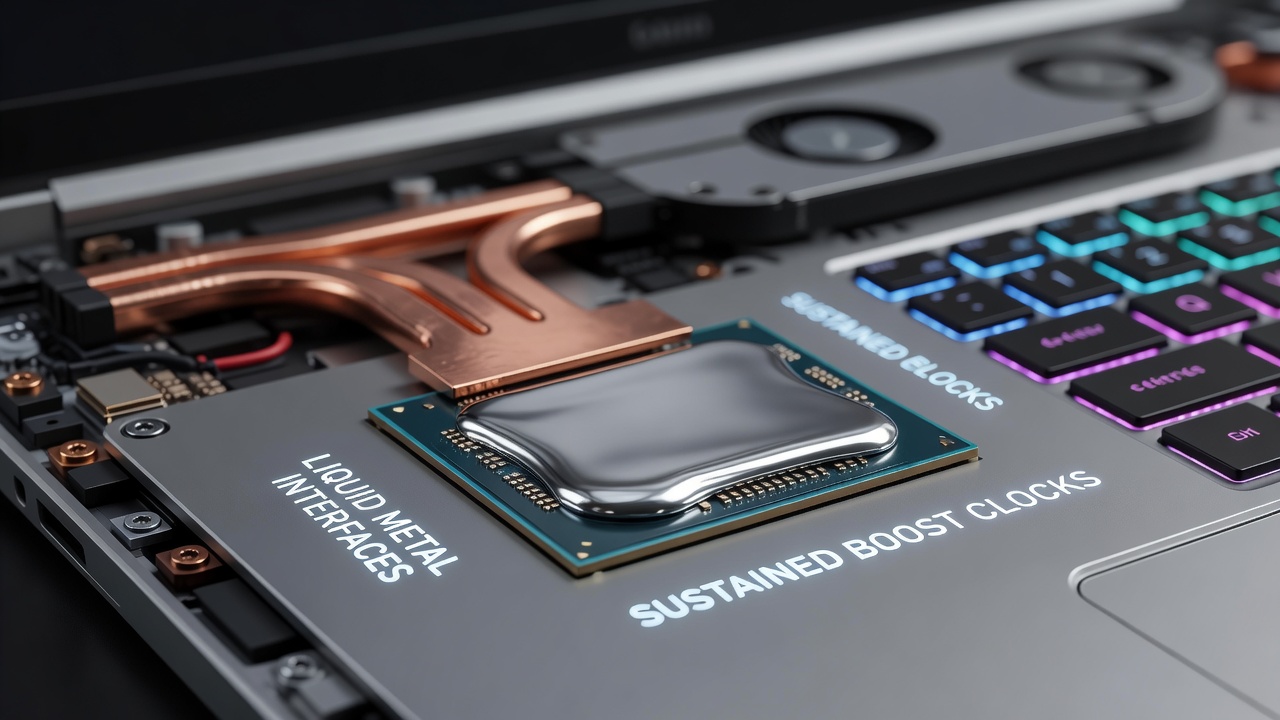
Liquid Metal Interfaces Enable Sustained Boost Clocks in Ultrathin Gaming Notebooks
Engineers have developed liquid metal thermal interface materials that maintain higher processor boost clocks for extended periods in slim gaming notebook designs, and these compounds transfer heat more effectively than traditional pastes because their metallic composition creates lower thermal resistance at contact points while researchers continue to refine formulations for consumer hardware released through 2026.
Thermal Management Challenges in Compact Designs
Ultrathin gaming notebooks face strict thickness constraints that limit heatsink volume and fan size, which causes processors to throttle boost clocks sooner during long sessions, yet liquid metal alloys based on gallium and indium fill microscopic surface gaps with greater efficiency than silicone-based pastes and data from component testing shows sustained clock rates remain elevated for hours rather than minutes under load.
Manufacturers incorporate these interfaces in chassis measuring under 20 millimeters thick where airflow paths stay restricted, and the material stays liquid at operating temperatures so it conforms dynamically as components expand and contract during marathon gaming sessions.
Performance Data from Recent Testing
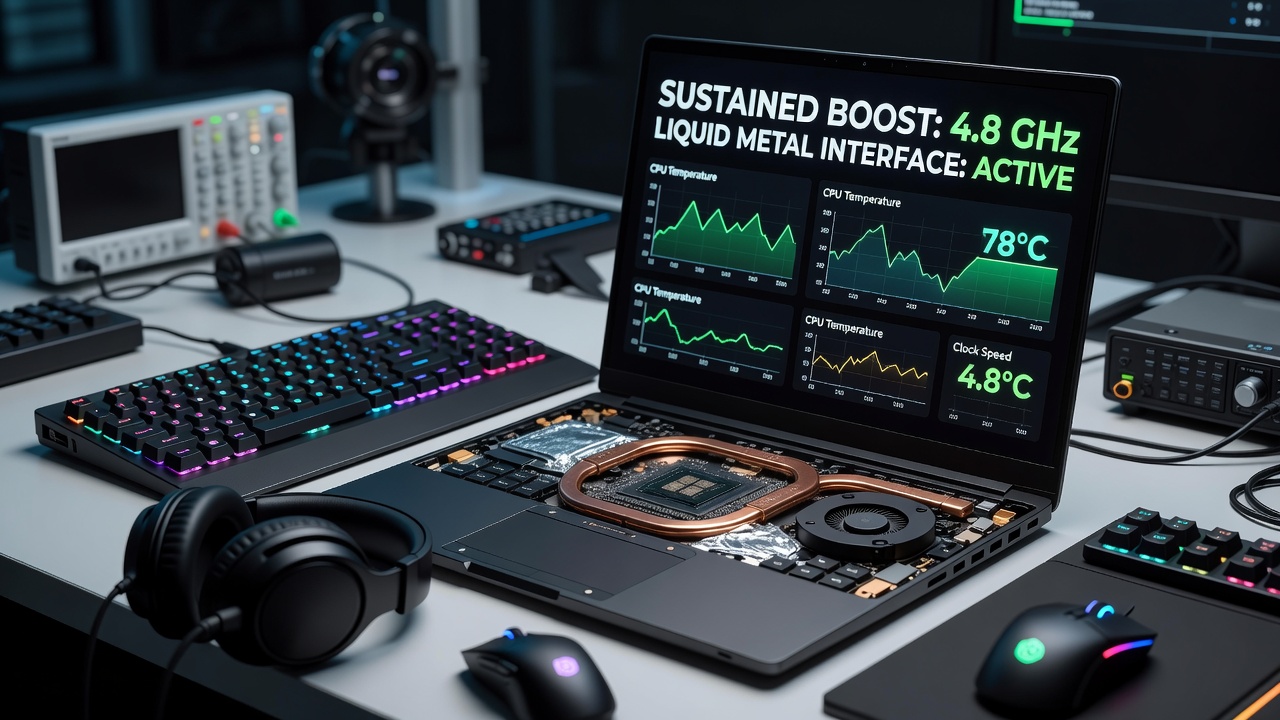
Benchmark results compiled in August 2026 by multiple hardware laboratories indicate systems using liquid metal interfaces held GPU boost frequencies within 5 percent of peak values across two-hour stress tests, whereas identical models fitted with conventional thermal compounds dropped 15 to 20 percent after the first 30 minutes. Observers note that power delivery components also benefit because lower operating temperatures reduce voltage droop and keep memory subsystems stable during prolonged high-frame-rate output.
Material Properties and Application Methods
Liquid metal formulations exhibit thermal conductivity ratings above 70 watts per meter-kelvin compared with 8 to 10 watts per meter-kelvin for standard pastes, and application requires precise dispensing equipment because the alloys react with aluminum surfaces and demand protective coatings on heatsink bases. Technicians apply the material in controlled volumes measured in microliters to prevent overflow that could reach motherboard traces and create short circuits during assembly.
Industry reports from the Semiconductor Industry Association highlight ongoing work to encapsulate these alloys in polymer matrices that reduce reactivity while preserving conductivity, and European research groups at Fraunhofer have published findings on hybrid compounds that combine liquid metal droplets with ceramic fillers for improved long-term stability in portable systems.
Integration in 2026 Notebook Platforms
Several ultrathin models scheduled for late 2026 feature factory-applied liquid metal layers paired with vapor chamber spreads and dual-fan arrays, and these configurations allow high-wattage mobile processors to sustain multi-core boost states without crossing thermal limits that previously forced frequency reductions. Test units evaluated at university labs in Canada demonstrated consistent frame delivery in open-world titles over four-hour periods when the new interfaces replaced older compounds.
Supply chain adjustments include specialized shipping protocols for the alloys because they remain conductive and require sealed containers during transit, while automated application stations on production lines now include vision systems that verify coverage area before final assembly.
Conclusion
Continued refinement of liquid metal interfaces supports higher sustained performance envelopes in space-constrained gaming notebooks, and ongoing material science work aims to extend service life while maintaining safety margins across consumer and professional portable platforms.