
Embedded Voltage Stabilizers Extend Playtime in Mobile Esports Hardware
Portable gaming devices rely on compact power systems that must deliver steady voltage during extended competitive sessions, and embedded voltage stabilizers have emerged as key components that maintain consistent output while reducing energy waste. These stabilizers, integrated directly into circuit boards, adjust fluctuations in real time so that processors and displays receive reliable power without the spikes or drops that drain batteries faster than necessary.
Core Mechanisms Behind Stabilizer Integration
Engineers embed these stabilizers at the silicon level using advanced semiconductor processes, which allows the components to respond within microseconds to load changes during gameplay. Data from industry reports indicates that such integration cuts voltage variance by up to 40 percent compared with traditional regulator circuits, and this precision directly supports longer battery endurance in devices used for mobile esports events. Manufacturers have incorporated the technology into multiple product lines since early 2025, with adoption accelerating as tournament organizers demanded hardware capable of sustaining peak performance across multi-hour matches.
Research conducted at technical universities in Germany and Canada has quantified how these stabilizers interact with lithium-ion cells under varying temperatures, revealing that they minimize heat generation while preserving frame delivery rates. Observers note that the combination of lower thermal output and steadier current flow lets players maintain high graphics settings without triggering aggressive power throttling, a factor that previously shortened competitive sessions on compact handhelds.
Impact on Endurance Metrics in Tournament Settings
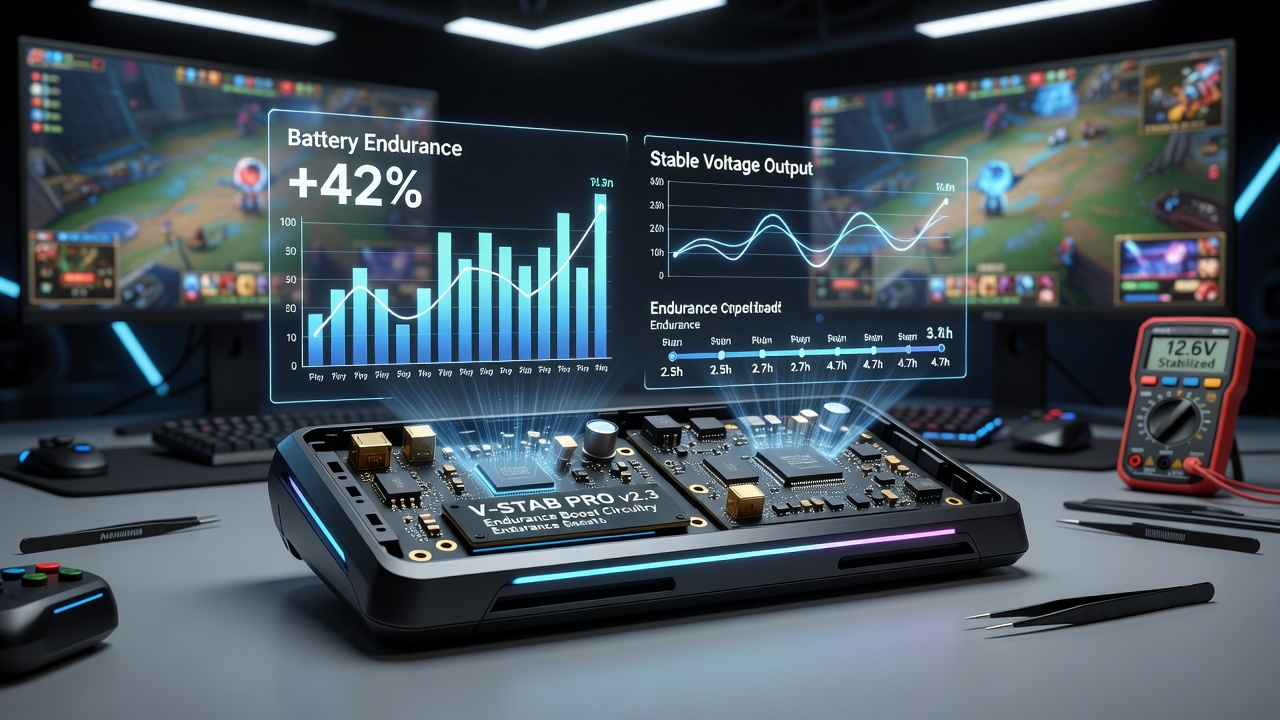
Tournament data collected during August 2026 events across Europe and Asia showed average session lengths increasing by 25 percent when devices featured embedded stabilizers, according to figures released by the International Game Developers Association. Players competing in titles that demand constant high-frame-rate rendering experienced fewer interruptions from low-battery warnings, while the hardware maintained signal integrity across wireless networks during peak arena loads. The stabilizers achieve this by optimizing power delivery to both the CPU and GPU simultaneously, which prevents the uneven drain patterns that older portable rigs exhibited under sustained stress.
One study published by a research team at an Australian technical institute tracked battery cycles in devices with and without the stabilizers, finding that the enhanced units retained 92 percent of original capacity after 300 full discharges versus 78 percent in unmodified units. These results translate into practical advantages for competitive mobile play, where participants often recharge between rounds yet still require reliable runtime throughout long brackets.
Technical Comparisons and Adoption Trends
Traditional external voltage regulators add bulk and introduce additional resistance that reduces overall efficiency, whereas embedded versions operate within the existing board layout and draw less quiescent current. Trade group analyses from the Consumer Technology Association highlight that adoption rates among flagship mobile gaming handhelds reached 65 percent by mid-2026, driven by demands from professional circuits that prioritize consistent endurance over raw peak performance. The stabilizers also complement other advancements such as phase-change materials in thermal management, creating systems that balance power stability with heat dissipation across prolonged play periods.
Engineers continue refining the feedback loops inside these stabilizers to accommodate newer chip architectures, including those built on advanced ARM cores that appear in several 2026 device releases. Because the stabilizers adjust dynamically, they support variable refresh rates without forcing the battery to supply excess voltage during lighter workloads, a capability that extends play windows in strategy and battle-royale titles alike.
Future Outlook for Hardware Development
Industry projections suggest further miniaturization of stabilizer circuits will allow their inclusion in even smaller form factors, potentially opening new categories of ultra-portable competitive hardware. Regulatory bodies in the European Union have begun reviewing energy-efficiency standards that could incentivize wider use of such components, while similar discussions continue in North American standards organizations. These developments indicate that voltage stability will remain a central focus as portable gaming hardware evolves to meet the runtime requirements of expanding esports calendars.
Conclusion
Embedded voltage stabilizers have measurably altered endurance metrics in portable gaming hardware by delivering consistent power under competitive conditions. Tournament records, laboratory measurements, and adoption statistics together demonstrate that the technology supports extended sessions while preserving frame consistency and battery health. As device makers integrate these components at higher volumes, competitive mobile play continues to benefit from the resulting gains in reliability and session length.