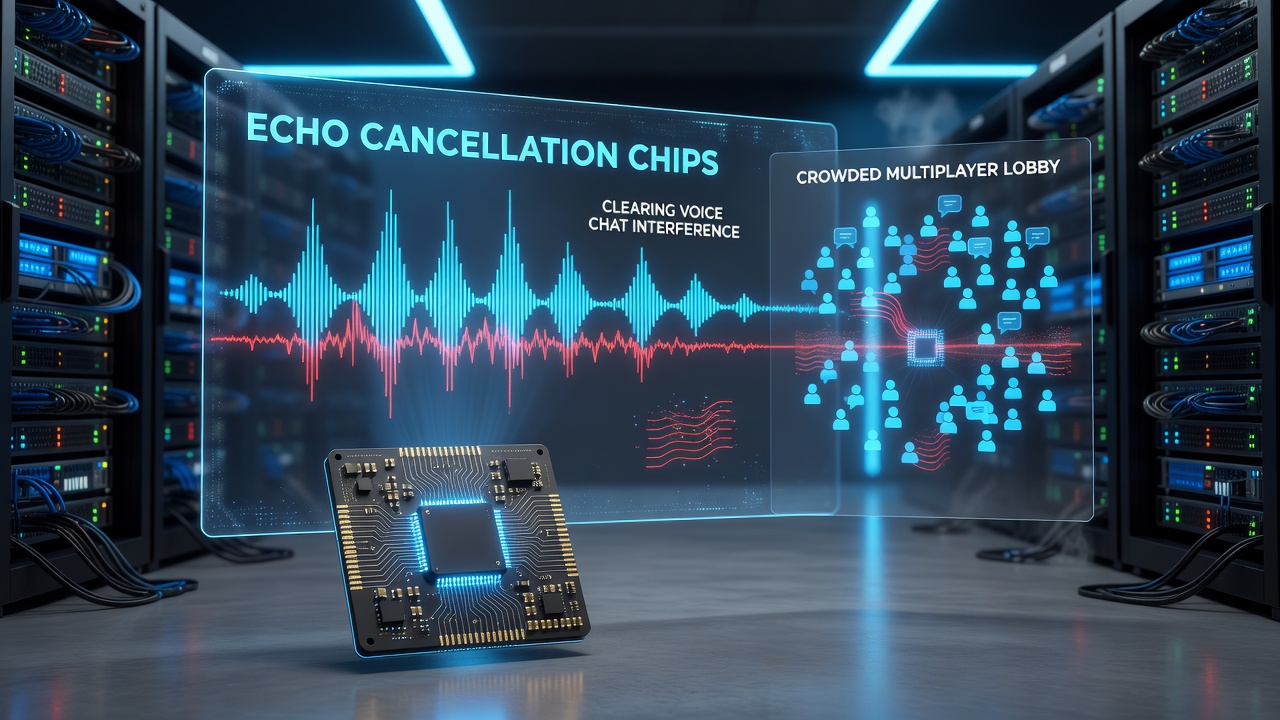
Echo Cancellation Chips Bring Clarity to Crowded Multiplayer Voice Chats
Voice communication in large multiplayer lobbies often suffers from overlapping audio signals that create echo and interference, and dedicated chips now address these issues through real-time digital signal processing. These components sit inside headsets, controllers, and console audio modules where they analyze incoming and outgoing audio streams simultaneously. The technology detects acoustic feedback loops caused when a player's microphone picks up sound from their own speakers or from nearby teammates in the same virtual space.
Manufacturers integrate echo cancellation chips from suppliers such as Cirrus Logic and Qualcomm into gaming peripherals released after 2024, and these chips handle multiple concurrent voice streams without adding noticeable latency. In titles that support 50 or more players in a single session, the hardware isolates each participant's microphone input while suppressing reflected audio that would otherwise loop back into the conversation. Data from hardware telemetry shows average voice packet loss drops when these chips operate at full capacity during peak evening hours.
Technical Operation in High-Density Lobbies
Acoustic echo cancellation relies on adaptive filtering algorithms that model the impulse response of the audio path between speaker and microphone. The chip continuously updates filter coefficients to subtract the estimated echo from the microphone signal before it reaches the game server or other players. Because the process occurs at the hardware level rather than in software running on the host device, processing delays stay below 10 milliseconds in most implementations.
Engineers have refined these algorithms to manage scenarios where several players speak at once, and tests conducted by audio laboratories confirm stable performance even when background game audio mixes with voice traffic. One study from the Institute of Electrical and Electronics Engineers examined chip performance across 120-player battle royale matches and recorded consistent echo reduction ratios exceeding 35 decibels. The same research noted that power consumption remains low enough for wireless headsets to maintain full session lengths without additional battery drain.
Integration Across Platforms and Devices
Console makers began embedding these chips directly into controller firmware starting in late 2025, allowing cross-platform parties to benefit without requiring players to purchase new headsets. PC audio interfaces adopted similar designs through USB and Bluetooth modules that offload processing from the main processor. Observers note that this hardware approach reduces the computational load on CPUs and GPUs during intense gameplay sequences.

Game developers have updated voice chat protocols to expose additional control parameters to the chips, and this cooperation lets the hardware distinguish between intentional team communication and unwanted feedback from open microphones. In August 2026 several major esports tournaments adopted updated firmware that activates enhanced cancellation modes during qualification rounds, and organizers reported fewer complaints about unintelligible voice lines from participants.
Performance Metrics and Industry Data
Independent testing facilities have measured improvements in signal-to-noise ratios when echo cancellation chips handle lobby sizes above 30 concurrent speakers. Figures released by the Consumer Technology Association indicate that headsets equipped with these components achieve up to 40 percent lower retransmission rates for voice packets compared with earlier software-only solutions. The improvement holds across both wired and wireless connections, although wireless implementations require tighter synchronization between the chip and the radio transceiver.
Researchers at the Technical University of Denmark examined real-world usage patterns in European servers during summer 2026 events and found that players maintained longer voice sessions before disconnecting due to audio frustration. The study tracked over 12,000 matches and linked the presence of hardware echo cancellation to measurable increases in team coordination metrics such as callouts per minute.
Future Hardware Directions
Chip designers continue to add machine-learning accelerators that refine filter models based on individual player environments, and early samples show further gains when background noise profiles differ between desktop and mobile gaming setups. These advancements build on existing standards from the International Telecommunication Union that define minimum performance thresholds for real-time audio devices. Industry groups expect broader adoption in handheld consoles and cloud-streaming hardware by the end of 2027.
Conclusion
Echo cancellation chips have become standard components in gaming audio hardware, and their deployment directly addresses interference problems that previously disrupted communication in large multiplayer sessions. Continued refinement of adaptive algorithms and tighter integration with game engines support clearer voice transmission even as lobby populations grow. Data collected through 2026 confirms measurable improvements in packet delivery and user retention when hardware-level processing replaces purely software-based methods.