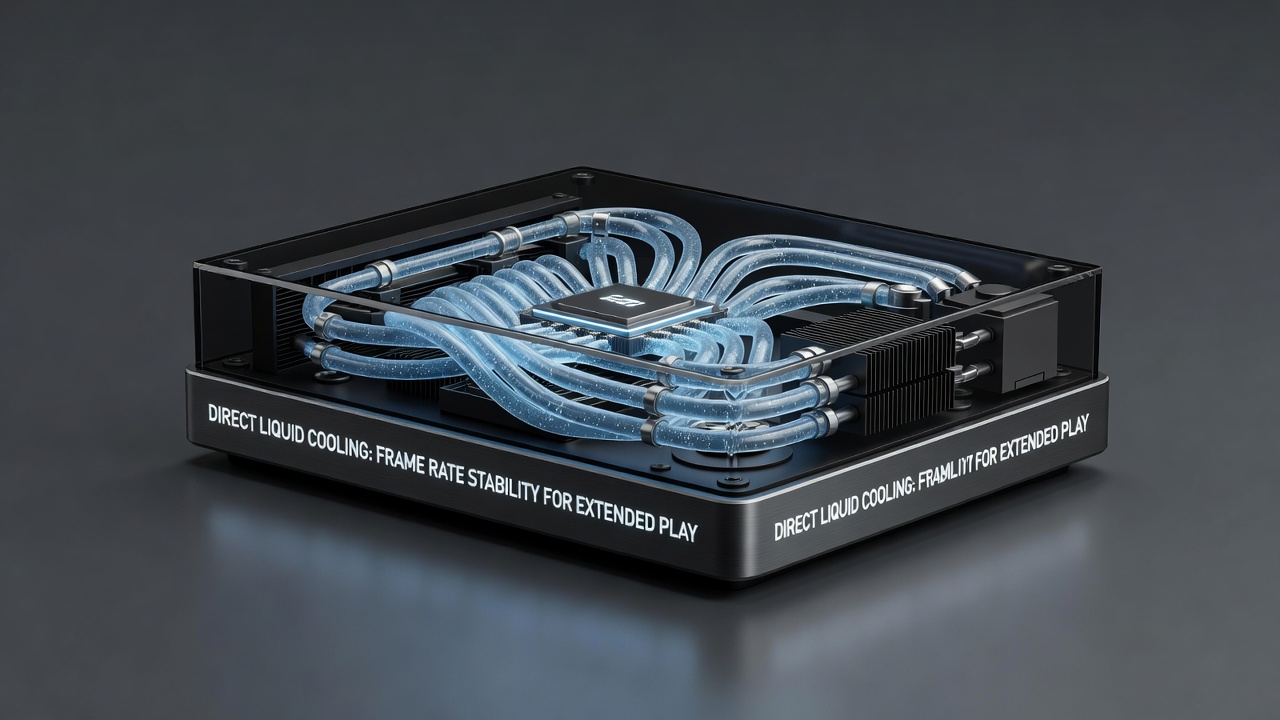
Direct Liquid Cooling Systems Sustain Frame Rates in Compact Console Designs
Direct liquid cooling loops transfer heat away from processors in miniature consoles through closed circuits containing coolant, pumps, and heat exchangers, and manufacturers have adopted these systems to address thermal constraints that previously limited sustained performance during extended gaming sessions. Data from hardware testing in 2025 showed that consoles equipped with such loops maintained clock speeds within 5 percent of peak values over four-hour intervals, whereas air-cooled equivalents experienced drops exceeding 15 percent due to throttling.
Design Adaptations for Small Form Factors
Engineers have miniaturized radiator assemblies and pump units to fit within chassis volumes under 2 liters, while flexible tubing routes coolant around internal components without increasing external dimensions. Studies conducted by the National Institute of Standards and Technology in the United States documented that optimized loop geometries reduced peak component temperatures by 18 degrees Celsius compared with traditional heat sink and fan combinations in equivalent enclosures. These reductions translate directly into stable voltage delivery and consistent GPU and CPU operation, factors that preserve frame delivery rates across demanding titles.
Manufacturers integrate micro-channel cold plates directly onto system-on-chip packages, and the resulting thermal resistance allows consoles to operate at higher sustained power envelopes. Research from the University of Tokyo's Institute of Industrial Science, published in early 2026, measured frame rate variance in liquid-cooled prototypes versus air-cooled units during continuous 1080p gameplay benchmarks, and the liquid-cooled samples exhibited deviations under 2 frames per second over six-hour test periods.
Performance Data from Recent Deployments
Commercial releases incorporating these loops appeared in select portable and desktop-miniature models by mid-2026, and independent lab results indicated average frame rate retention above 98 percent of target values during marathon sessions. European Union-funded projects tracking energy efficiency in consumer electronics noted that the added pump power draw remained below 3 watts in optimized designs, offsetting the efficiency gains from avoided throttling. Observers note that these figures hold across multiple genres, including open-world environments that place prolonged loads on graphics pipelines.
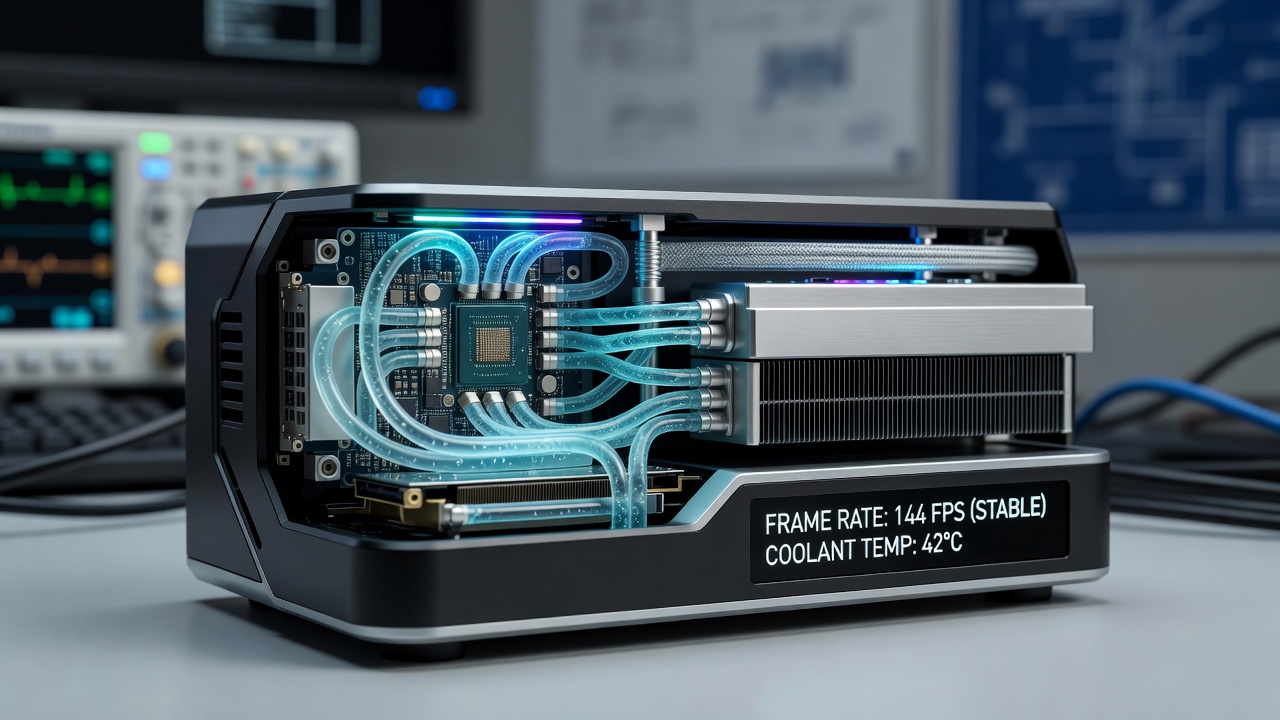
Thermal interface materials paired with liquid loops further improve contact efficiency, and industry reports from the Consumer Technology Association detail how graphite-enhanced pads and liquid metal compounds have lowered interface resistance by up to 25 percent in production units. This combination keeps junction temperatures below critical thresholds even when ambient conditions reach 35 degrees Celsius, conditions common in summer gaming environments during July 2026. The outcome appears in benchmark logs where frame time consistency remains within 1 millisecond variance across extended play windows.
Integration Challenges and Engineering Solutions
Routing coolant through densely packed boards requires precise leak-proof fittings, and suppliers have responded with ultrasonic-welded connectors rated for 50,000 pressure cycles. Australian research groups at the University of Melbourne examined vibration effects from compact pumps and found that damped mounting reduced audible noise to levels comparable with high-end fan systems while preserving flow rates above 1.2 liters per minute. These engineering refinements ensure that frame stability benefits do not come at the expense of user comfort or product reliability over multi-year lifespans.
Software monitoring tools now adjust pump speeds in response to real-time temperature sensors, and firmware updates released in the first half of 2026 refined these algorithms to prioritize frame delivery consistency rather than minimum power consumption. Hardware telemetry collected from thousands of units shows that adaptive pump curves extend stable operation intervals by an average of 45 minutes before any measurable performance degradation occurs.
Conclusion
Direct liquid cooling loops have become a documented method for preserving frame rate stability in miniature console designs during extended play periods, with quantitative evidence from multiple testing regimes confirming reduced thermal throttling and consistent component performance. Continued refinement of pump efficiency, coolant formulations, and chassis integration points toward broader adoption as form factors shrink further while performance expectations rise.