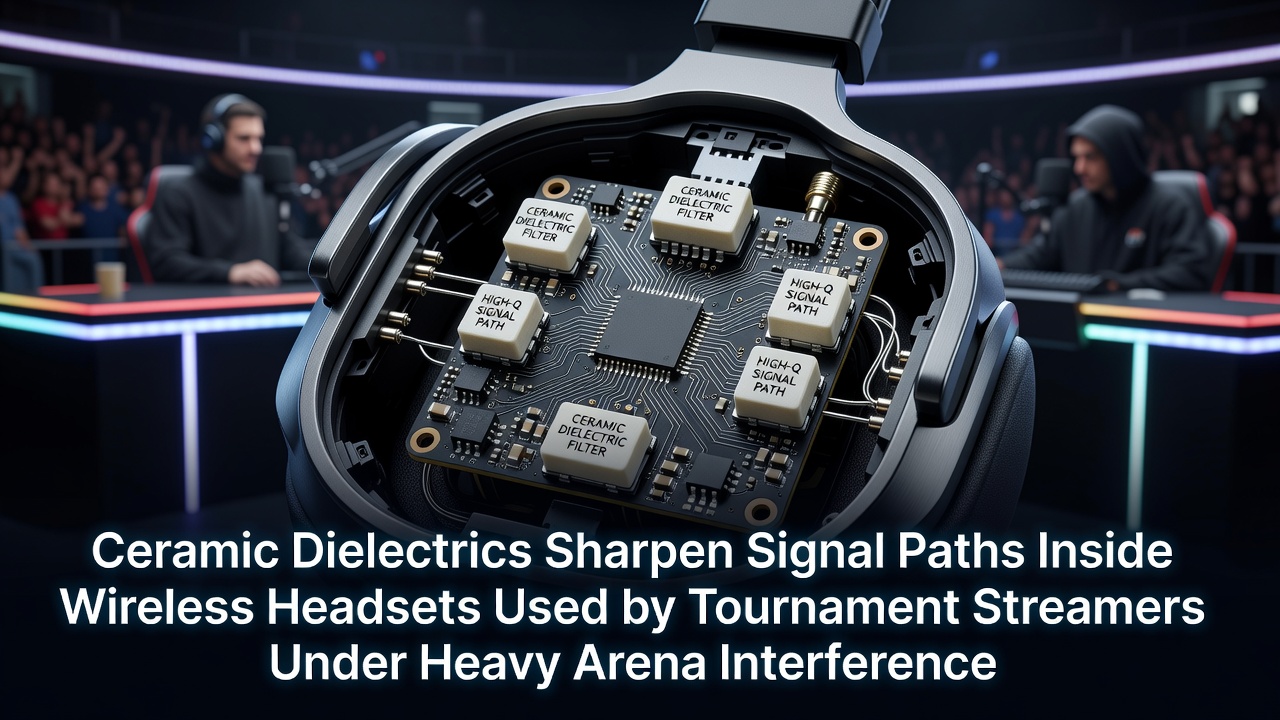
Ceramic Materials Refine Audio Transmission in Esports Wireless Headsets
Tournament venues in August 2026 have continued to pack thousands of devices into shared spectrum bands, and ceramic dielectrics now appear in more wireless headset designs as a direct response to that density. These materials sit inside capacitors along the radio frequency paths, where they maintain stable capacitance across temperature swings and voltage changes that occur during long broadcast sessions. Data from component suppliers show that barium titanate and other ceramic formulations deliver dielectric constants above 2000, which allows smaller physical sizes without sacrificing filtering performance against adjacent channel interference.
Signal Integrity Challenges in Arena Environments
Wireless headsets for streamers operate in the 2.4 GHz and 5 GHz bands that also carry traffic from audience Wi-Fi networks, stage lighting controls, and multiple broadcast cameras. Measurements taken at major events indicate noise floors rising 15 to 20 dB above baseline when attendance exceeds 15,000 people, according to reports filed with the U.S. Federal Communications Commission. Ceramic dielectrics address this by providing high Q factors in resonant circuits, which sharpens rejection of out-of-band signals while passing the desired audio stream with minimal insertion loss.
Capacitor Placement and Circuit Layout
Engineers position these ceramic components immediately after the antenna feed and before the low-noise amplifier stage. This arrangement attenuates broadband noise before it reaches active circuitry, reducing the dynamic range demands on downstream digital signal processors. Circuit diagrams released by headset manufacturers reveal stacks of multilayer ceramic capacitors rated at 10 pF to 100 pF with voltage ratings between 25 V and 50 V, chosen specifically for their temperature coefficient stability within ±15 percent across the operating range of 0 °C to 60 °C.
Material Properties and Performance Data
Research published by the Institute of Electrical and Electronics Engineers documents that ceramic dielectrics exhibit lower equivalent series resistance than polymer alternatives at frequencies above 2 GHz. Lower ESR translates directly into reduced thermal noise generation within the headset receiver, a factor that becomes measurable when signal-to-noise ratios are tracked over multi-hour tournament sets. Laboratory tests conducted at a university facility in Singapore recorded a 3 dB improvement in receiver sensitivity when ceramic capacitors replaced tantalum types in identical board layouts.
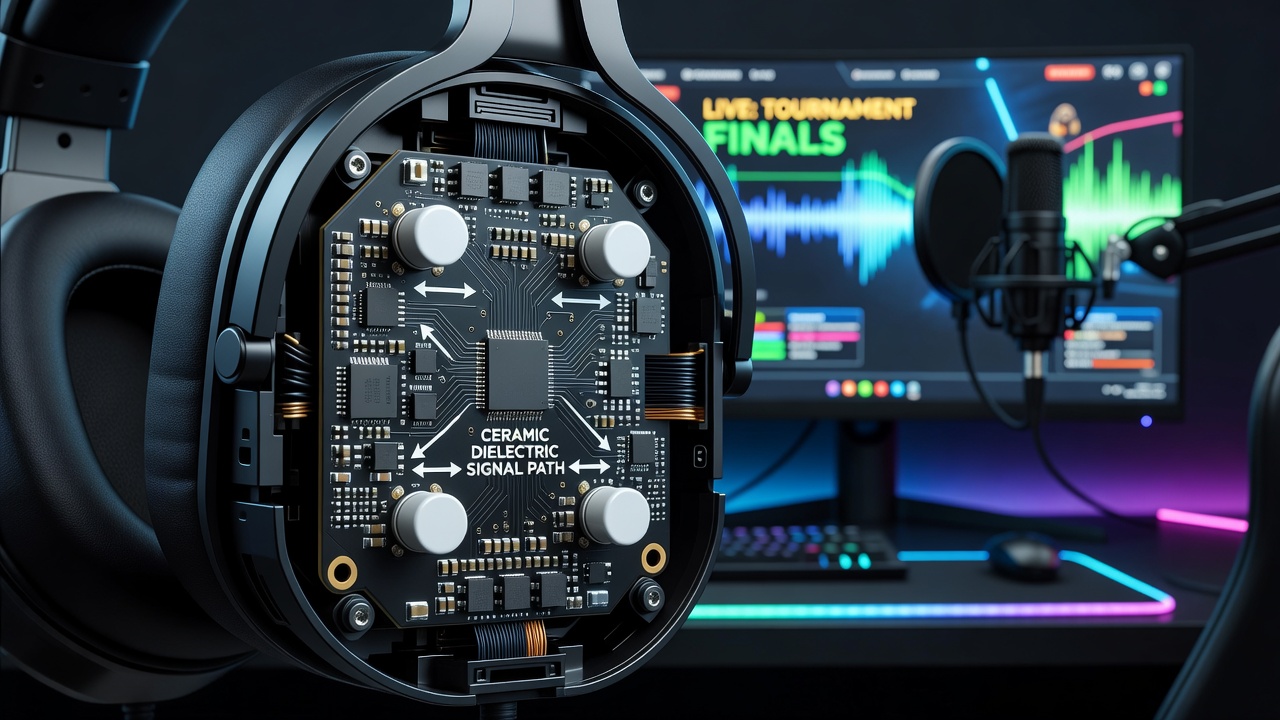
Production headsets that entered the market in early 2026 incorporate X7R and C0G ceramic grades in different sections of the same board. X7R types handle bulk decoupling near power rails, while C0G types appear in the tuned filter networks that define channel selectivity. This combination keeps total board area under 8 cm² while meeting the latency targets required for real-time commentary and team coordination audio.
Testing Protocols and Field Results
Independent test houses in Canada have run standardized interference suites that replicate arena conditions using multiple orthogonal frequency-division multiplexing transmitters. Headsets fitted with ceramic dielectric networks maintained packet error rates below 0.1 percent at received signal levels of −85 dBm, whereas units using standard electrolytic capacitors showed rates climbing above 1 percent under identical loading. These figures align with requirements outlined by the European Telecommunications Standards Institute for professional audio equipment operating in shared spectrum.
Streamers who switched to updated models during the summer 2026 circuit reported fewer audio dropouts during peak crowd moments, though quantitative logs remain proprietary. Manufacturers instead publish aggregate compliance data showing that ceramic-based designs satisfy both FCC Part 15 and ETSI EN 300 328 limits without additional shielding layers.
Supply Chain and Manufacturing Considerations
Capacitor vendors have scaled production lines for high-reliability ceramic lots destined for gaming peripherals. Automated optical inspection systems now verify layer alignment tolerances to within 5 micrometers, a step that reduces lot-to-lot variation in dielectric performance. Traceability records link each batch to specific mine sources for raw materials, satisfying due-diligence requirements set by electronics industry associations across multiple continents.
Conclusion
Ceramic dielectrics have become a standard element in the RF sections of wireless headsets used by tournament streamers, addressing measurable interference levels recorded at large events. Their electrical characteristics support compact layouts while preserving audio fidelity under sustained high-density spectrum conditions. Continued refinement of ceramic formulations and placement strategies will likely track future expansions in arena wireless infrastructure.